

For most of our history, human evolution happened in our bodies. It took hundreds of thousands of years to change a jaw, a hand, or the size of a brain.
Then we started evolving through our tools. Fire, language, writing, the printing press, electricity. Each one changed how we live, think, and connect without changing a single gene.
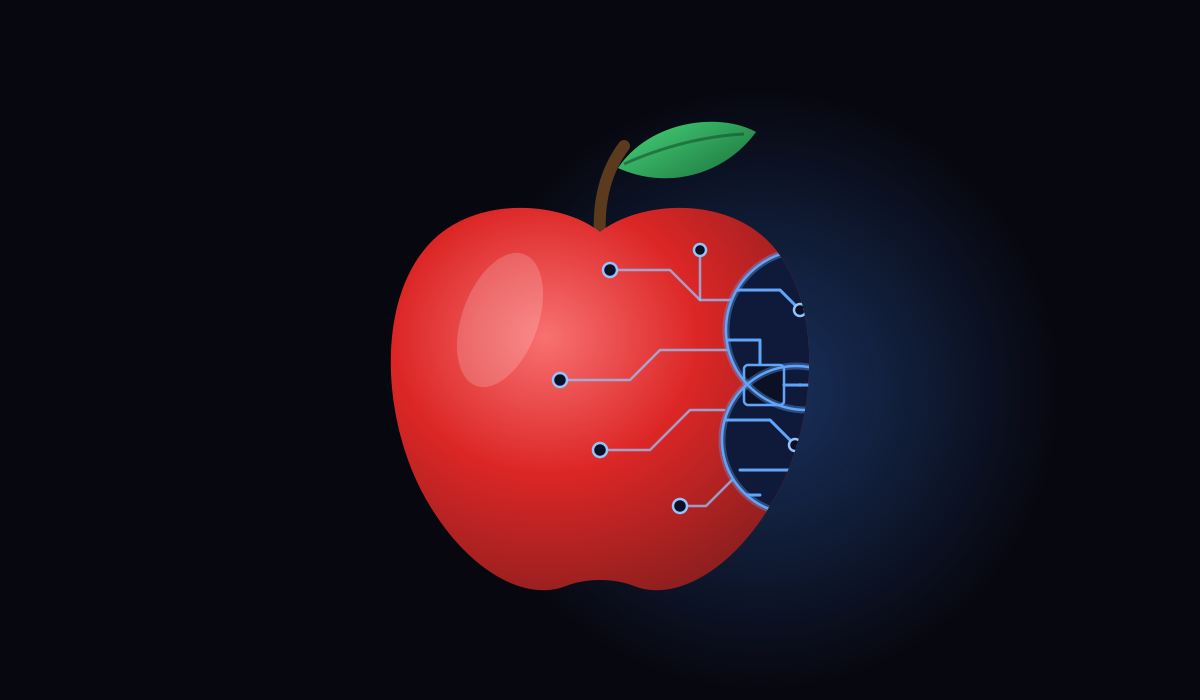
I believe we are now at the point where the tools stop staying in our hands. They are moving onto our bodies, into our routines, and in some cases into our brains. We are becoming cyborgs, part human and part machine, and most of us did not notice the moment it started.
The Bite in the Apple
Look at the logo on the back of an iPhone or a MacBook. It is an apple with a bite taken out of it.
To me, that bite has always read like the forbidden fruit from the Garden of Eden. In that story, one bite changes everything. Knowledge comes in, innocence goes out, and there is no way back to the garden. The results are both good and bad, and they shape everyone who comes after.
I want to be clear that this is my interpretation, not Apple's. The designer of the logo, Rob Janoff, has said the bite was added so the shape would read as an apple instead of a cherry or a tomato, and that the "byte" pun was a happy accident (9to5Mac interview). Apple has never said the logo is a biblical reference.
Still, symbols take on meaning beyond what their designers intended. Whatever the reason for the bite, the device carrying that logo helped make the always-connected smartphone part of everyday life. We took the bite. Things changed, and they are still changing. I think the change will impact the human race as we know it.
The Signs Are Already Here
Machines in the Brain
The most literal version of the cyborg is a brain-computer interface.
Neuralink, the company co-founded by Elon Musk, implanted its first device in a human patient in January 2024 as part of its PRIME study. The patient, Noland Arbaugh, has been paralyzed below the shoulders since a diving accident. In a livestream about two months later, he showed himself playing online chess by controlling a computer cursor with his thoughts (Popular Science).
That is genuinely life-changing for someone who cannot use their hands. It is also a preview. These devices are still investigational and are being tested in clinical trials, not sold to the public. Researchers outside the company have also cautioned against overhyping what the demonstrations show. But the direction is clear: the line between a person and a computer is starting to run through the skull.
Workers Training Their Replacements
The second sign is less dramatic and, in my opinion, more important for most people.
Robots learn physical tasks by watching humans do them. So companies are recording humans at work.
- In India, NPR reported on textile factory workers wearing head-mounted cameras that record their hand movements so the footage can be used to train AI robots. Some workers were never told what the recordings were for. One worker said she expects to be replaced someday (NPR via KUNC).
- Similar reporting describes workers wearing forehead cameras and smart glasses during shifts, with data companies making deals with factory management rather than with the workers themselves (eWeek).
- In Germany, Handelsblatt reported that selected employees at Tesla's Grünheide factory will wear backpack-mounted cameras that capture how they grip tools and handle parts, so the footage can train Tesla's Optimus humanoid robot (electrive).
Think about what that means. The worker's body becomes a sensor. Their skill becomes training data. The person and the machine are linked, and the knowledge flows in one direction.
To be fair, the same NPR report quotes experts who doubt robots will replace these workers at scale anytime soon, because humans are still cheaper than robots in many places. Whether that stays true is the question.
Talking to Machines Instead of Each Other
The third sign is in our conversations.
People now talk to chatbots for work, for advice, and for company. I use AI every day, and I know how useful it is. But a pair of studies from OpenAI and the MIT Media Lab found that heavier ChatGPT use was linked to greater loneliness and lower socialization, especially for people who formed emotional attachments to the chatbot (Engadget).
There are important caveats. The studies were short, not yet peer reviewed at the time, and the researchers said they could not tell whether chatbot use causes loneliness or lonely people turn to chatbots. Emotional conversations were also uncommon for most users. But the pattern is worth watching.
The Commute
The fourth sign is one anyone can see.
Ride public transportation and look around. Nearly everyone is looking down at a phone. Earbuds in, eyes on a screen, connected to the whole world and to nobody in the same car.
The phone is not inside our bodies, but it might as well be. It holds our memory, our directions, our conversations, and our attention. Take it away and most of us feel like something is missing. That is what a cyborg is.
The Upside
I do not want to tell only half the story.
Brain-computer interfaces could give people with paralysis back the ability to communicate, work, and play. AI tools can help a small business owner do the work of a whole team. Robots can take over jobs that are dangerous, repetitive, or hard on the body. A chatbot can be a real help to someone who needs an answer at 2 a.m. and has nobody to call.
Every tool in human history has been used for good and for harm. The bite brought knowledge too.
The Downside: Jobs and Unrest
The part that worries me most is work.
A Stanford Digital Economy Lab study by Erik Brynjolfsson, Bharat Chandar, and Ruyu Chen, using payroll data from ADP, found that employment for workers aged 22 to 25 in the occupations most exposed to AI has fallen well below where it would have been if it had kept pace with similar workers in less exposed jobs. More experienced workers did not show the same gap, and the decline came mainly from companies hiring fewer young people (Stanford Digital Economy Lab). The authors describe these as early warning signs, not proof of cause, and they found no evidence of economy-wide job losses so far.
That is exactly the pattern I fear. The entry-level and lower-level jobs disappear first. What remains is a smaller group of managers and high-level decision makers directing AI systems. But entry-level jobs are how people learn, build careers, and eventually become those decision makers. If the bottom rungs of the ladder disappear, how does anyone climb?
And people who lose their jobs still have to pay rent and feed their families. History tells us what can happen when technology removes livelihoods faster than society can adjust. In early 19th-century England, textile workers known as the Luddites smashed the machines they believed were taking their work (Britannica). I do not think riots are inevitable. But I think unrest is a real risk if millions of people feel the change is happening to them instead of with them.
Where I Land
I am hopeful, but carefully.
We cannot un-bite the apple. The technology is here, and it will keep moving into our tools, our work, and our bodies. The question is not whether we become cyborgs. It is what kind of cyborgs we choose to become, and who gets left behind along the way.
Here is what I think would help:
- Companies: Be honest with workers when their work is being recorded to train AI, get real consent, and share the value that data creates.
- Governments: Prepare now with retraining, a stronger safety net, and policies that protect people through the transition, instead of reacting after the damage is done.
- Employers: Keep hiring and training entry-level people. A business with no apprentices today will have no experts tomorrow.
- All of us: Learn the tools, but learn how to step away from them too.
That last one sounds like the easiest item on the list. I think it is the hardest.
The Hardest Part: Stepping Away
Putting the phone down used to be the default. Now it takes real effort.
Our work lives in our devices. So do our friends, our family, our news, our banking, our maps, and our memories. Messages arrive all day and into the night. If you do not answer quickly, people wonder what is wrong. Even the tools I find most useful, the AI tools I work with every day, are always there and always ready for one more question. There is no natural stopping point anymore. The day does not end when you leave the office, because the office comes home in your pocket.
It can get overwhelming. The constant stream of information, notifications, and conversations does not leave much room to just be a person. And because everyone around us is plugged in, choosing to unplug can feel like falling behind.
That is why I believe taking time away from technology has to be a deliberate practice, not something we hope will happen on its own. It does not matter much what form it takes:
- Meditation: Sitting quietly with your own mind, without a screen telling you what to think about next.
- Prayer: Turning toward faith and something bigger than yourself, in whatever tradition speaks to you.
- Time outside: A walk, a hike, or a few minutes in the sun without headphones.
- Time with people: A meal, a conversation, or a game where the phones stay in another room.
- Rest: Simply doing nothing for a while, which may be the hardest of all.
None of these are new. People have prayed, meditated, walked, and gathered for thousands of years. What is new is how hard we now have to work to protect the time for them.
Here is the honest truth: this takes effort, and most of us will fail at it sometimes. I do. You might start a morning with the intention of sitting quietly and find yourself scrolling ten minutes later without remembering picking up the phone. That is not a personal failing. It is what happens when a device becomes part of how you think and remember. It is part of becoming a cyborg.
So the practice has to be built on purpose. Set times when the phone is off or in another room. Keep it out of the bedroom. Turn off the notifications you do not need. Tell the people in your life when you will be unreachable so the silence does not worry them. Protect those moments the same way you would protect an important meeting, because they matter more.
If we are going to merge with our machines, we also need a place where we are only human. A place to breathe, reflect, pray, or simply be still. Without it, I think we lose something no technology can give back.
The bite changed everything once before. It is changing everything again. Our job is to make sure the knowledge we gain is used to lift people up, not to leave them behind, and to remember that we can still close our eyes, set the device down, and find our way back to ourselves.